
When a new plastic part is ready to move toward production, it’s tempting to think the hardest work is already done. The CAD model is complete, the concept has been approved, and everyone is eager to begin manufacturing.
But one of the most expensive mistakes in product development happens before the first part is ever molded.
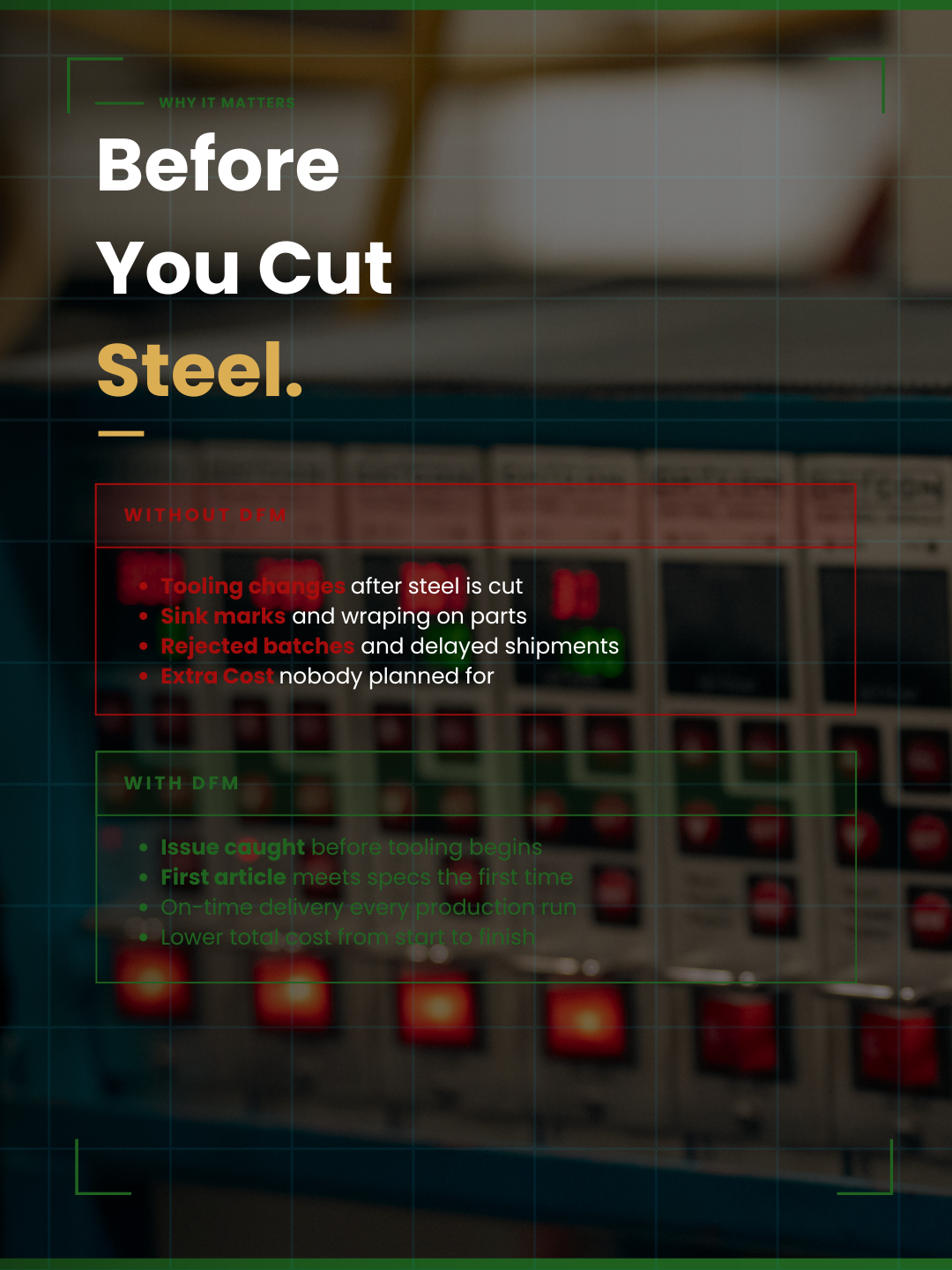
Once a mold is cut, making changes becomes significantly more expensive. Even relatively small design revisions can require machining, welding, or—in the worst cases—building an entirely new tool. These changes not only increase injection molding costs but also delay production schedules and product launches.
That’s why experienced manufacturers invest time in thorough planning before tooling begins. At Nylacarb, we believe the most valuable part of any project often happens during the conversations leading up to production.
Here are five discussions every product designer, engineer, and purchasing team should have before cutting steel.
1. Is This Part Truly Designed for Manufacturing?
A CAD model may look perfect on a computer screen, but that doesn’t necessarily mean it’s optimized for injection molding.
One of the first conversations should focus on Design for Manufacturability (DFM)—the process of evaluating whether a part can be produced efficiently, consistently, and cost-effectively.
During a DFM review, your manufacturing partner looks for opportunities to improve both production and long-term performance. Common discussion points include:
- Wall thickness consistency
- Proper draft angles for part ejection
- Rib and boss placement
- Undercuts that may require additional tooling
- Gate locations and material flow
- Sink marks, warpage, and cosmetic considerations
Even small design adjustments can have a significant impact on production costs.
For example, adding an appropriate draft angle may allow a part to eject cleanly without sticking to the mold. Adjusting wall thickness can reduce cooling time, shortening cycle times and lowering the cost of every part produced.
These are the types of improvements that are inexpensive to make before tooling—but costly after the mold has already been built.
2. Is the Selected Material the Best Fit for the Application?
Choosing a resin isn’t simply about selecting “plastic.”
Thousands of engineering-grade materials exist, each offering different combinations of strength, flexibility, chemical resistance, UV stability, temperature performance, wear resistance, and cost.
Selecting the wrong material early can lead to product failures, increased warranty claims, or unnecessary manufacturing expenses.
Before tooling begins, discuss questions such as:
- Will the part experience high temperatures?
- Is chemical resistance required?
- Will the component be exposed to sunlight or outdoor environments?
- Does it need FDA-compliant or medical-grade materials?
- Are impact resistance or flexibility priorities?
- Are there weight reduction goals?
Sometimes a premium material is absolutely necessary. Other times, a more economical resin can provide identical performance while significantly reducing production costs.
An experienced injection molding partner (like ourselves) can recommend materials based on both engineering requirements and manufacturing efficiency, helping ensure the part performs as intended without overspending.
3. Is the Tool Designed for Today’s Needs—or Tomorrow’s Growth?
Many companies understandably focus on getting their first production run completed as quickly as possible.
However, it’s equally important to consider where the product may be one, three, or even five years from now.
A mold represents a long-term investment. Decisions made during tooling can affect production capacity for years.
Questions worth discussing include:
- What annual production volume is expected?
- Is a single-cavity mold sufficient?
- Would a multi-cavity mold lower long-term part costs?
- Is a family mold appropriate?
- Could automation be incorporated later?
- What is the expected lifespan of the tool?
For lower-volume projects, a single-cavity mold may make financial sense. As demand increases, however, a multi-cavity mold can dramatically reduce per-part costs by producing multiple components during each machine cycle.
Planning for future growth early often avoids expensive tooling modifications later.
Similarly, designing with automation in mind—even if automation isn’t immediately implemented—can provide valuable flexibility as production scales.
4. How Will Quality Be Measured Throughout Production?
Quality doesn’t begin during final inspection. It begins long before production starts by identifying which dimensions and characteristics are truly critical. One of the most valuable conversations before tooling focuses on establishing quality expectations from day one.
Topics often include:
- Critical-to-function dimensions
- Cosmetic appearance requirements
- Acceptable tolerances
- First Article Inspection (FAI)
- Statistical Process Control (SPC)
- Sampling frequency
- Documentation requirements
- Customer-specific inspection plans
Having these expectations defined before production begins reduces misunderstandings and helps ensure consistent results throughout the life of the program.
At Nylacarb, our ISO 9001:2015-certified quality management system emphasizes proactive quality control rather than reactive inspection. Regular in-process quality checks and documented inspection procedures help maintain consistency across production runs while providing customers with confidence in every shipment.
When quality requirements are discussed early, both the customer and manufacturer have a clear roadmap for success.
5. Are We Looking at the Total Cost of Production?
When evaluating tooling, many companies naturally focus on the initial mold price. While tooling cost is important, it represents only one portion of the total cost of ownership.
A mold that costs less upfront but produces slower cycle times, requires excessive maintenance, or generates unnecessary scrap may ultimately cost far more over the life of the program.
Instead, manufacturers should discuss factors such as:
- Expected cycle time
- Tool maintenance requirements
- Material utilization
- Scrap rates
- Secondary operations
- Assembly efficiency
- Production scalability
- Overall lifecycle costs
Sometimes a modest investment during tooling can dramatically reduce manufacturing costs over hundreds of thousands—or even millions—of parts.
Likewise, thoughtful design decisions can simplify assembly, reduce labor, eliminate secondary machining, or improve packaging efficiency.
The goal isn’t simply to build the least expensive mold. The goal is to build the right mold for long-term manufacturing success.
The Value of Early Collaboration
One of the biggest misconceptions in manufacturing is that the injection molder only becomes involved after the design is complete. In reality, the earlier your manufacturing partner joins the conversation, the more opportunities exist to improve the final outcome.
Early collaboration allows engineers, designers, and molders to identify potential challenges before they become expensive problems.
A productive pre-tooling discussion often uncovers opportunities to:
- Simplify part geometry
- Reduce material usage
- Improve moldability
- Increase production efficiency
- Enhance product durability
- Reduce overall injection molding costs
- Shorten production lead times
Rather than viewing these conversations as delays, they’re better viewed as investments in a smoother production process.
Many of the most successful manufacturing programs aren’t successful because problems never arise—they’re successful because the right questions were asked before production began.
Partnering for Long-Term Success
Every molded part represents a series of engineering decisions that began long before the first machine cycle.
Taking the time to discuss manufacturability, material selection, tooling strategy, quality expectations, and long-term production goals can save significant time and money while improving overall product performance.
At Nylacarb, we believe the best manufacturing partnerships begin with collaboration. Our team works closely with customers during the planning phase to help identify opportunities for improved manufacturability, reduced costs, and consistent production quality. Whether you’re developing a new product or preparing an existing design for production, early communication can make all the difference.
Before you cut steel, make sure you’ve had the conversations that matter most. A thoughtful approach today can help prevent costly redesigns tomorrow—and lay the foundation for a successful manufacturing partnership that lasts for years.
Have more questions?
👉 Contact us today to discuss your next project.