
How Additives, Colorants, and Material Modifications Improve Performance
When most people think about plastic injection molding additives, they picture specialty chemicals that improve the performance of a finished part. While additives certainly play an important role, material customization goes far beyond that. Modern plastic injection molding allows manufacturers to tailor a resin’s properties through colorants, fillers, reinforcements, stabilizers, and other performance-enhancing modifications that improve strength, durability, appearance, and functionality. Whether you’re developing components for aerospace, defense, medical devices, industrial equipment, or consumer products, understanding how plastic materials can be customized can help ensure your product performs exactly as intended while maximizing long-term value.
Whether you’re developing components for aerospace, defense, medical devices, industrial equipment, or consumer products, understanding how plastic materials can be customized can lead to longer-lasting, higher-performing products.
Material Selection Is Just the Beginning
Every application presents a unique set of design challenges. A plastic component used inside industrial machinery has very different performance requirements than one exposed to direct sunlight, harsh chemicals, or repeated impact.
When evaluating materials, engineers often consider factors such as:
- Mechanical strength
- Flexibility
- Heat resistance
- Chemical resistance
- Dimensional stability
- Weight
- Surface appearance
- Regulatory requirements
- Production costs
While selecting the right base resin addresses many of these needs, additional material modifications often provide the final level of performance necessary for demanding applications.
This ability to tailor material properties is one of the reasons custom injection molding remains such a versatile manufacturing solution. Rather than forcing a product to fit within the limitations of a standard material, manufacturers can often customize the material itself to better fit the product.
Custom Colorants: More Than Just Appearance
Color is often viewed as purely cosmetic, but in many industries it serves an important functional purpose.
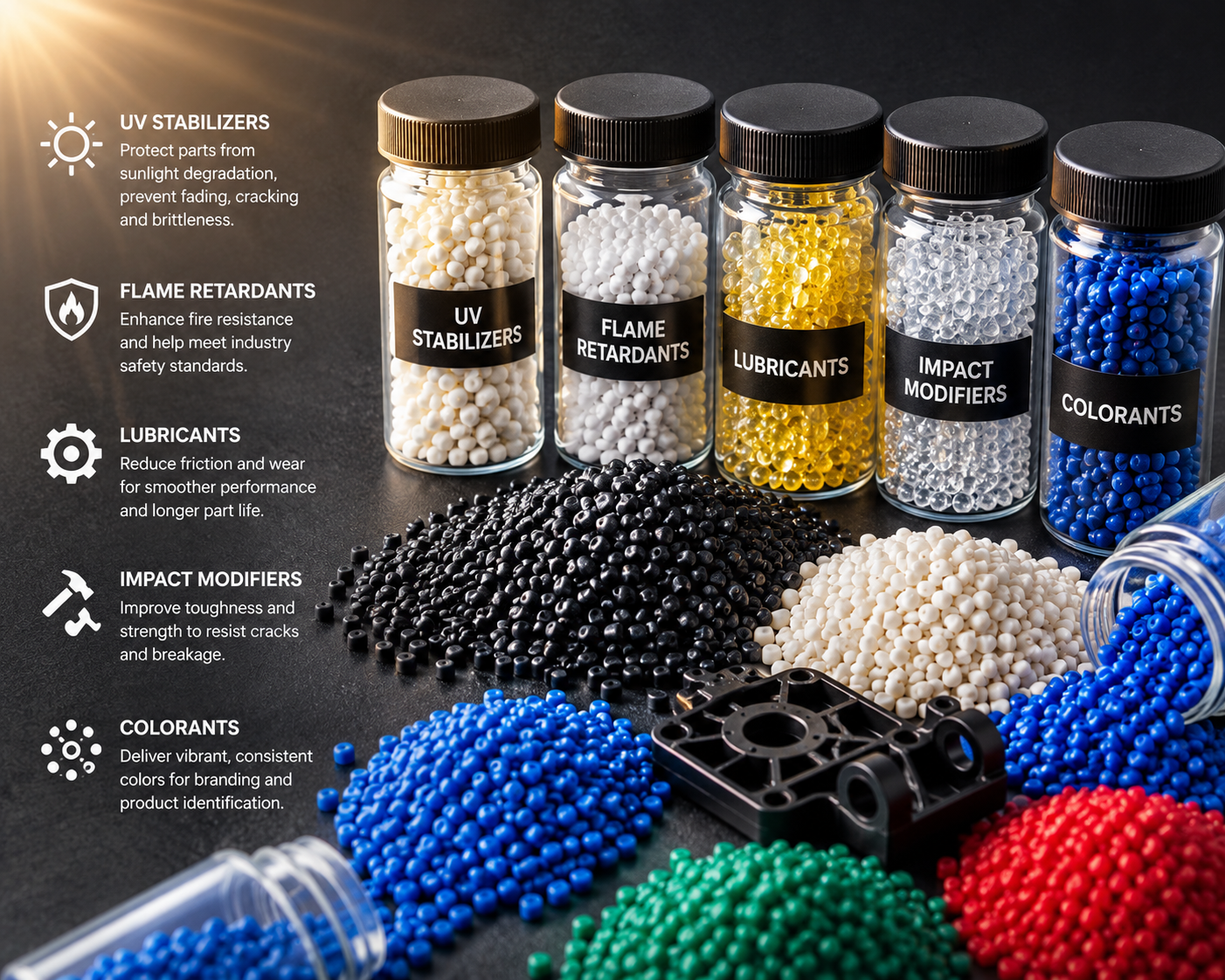
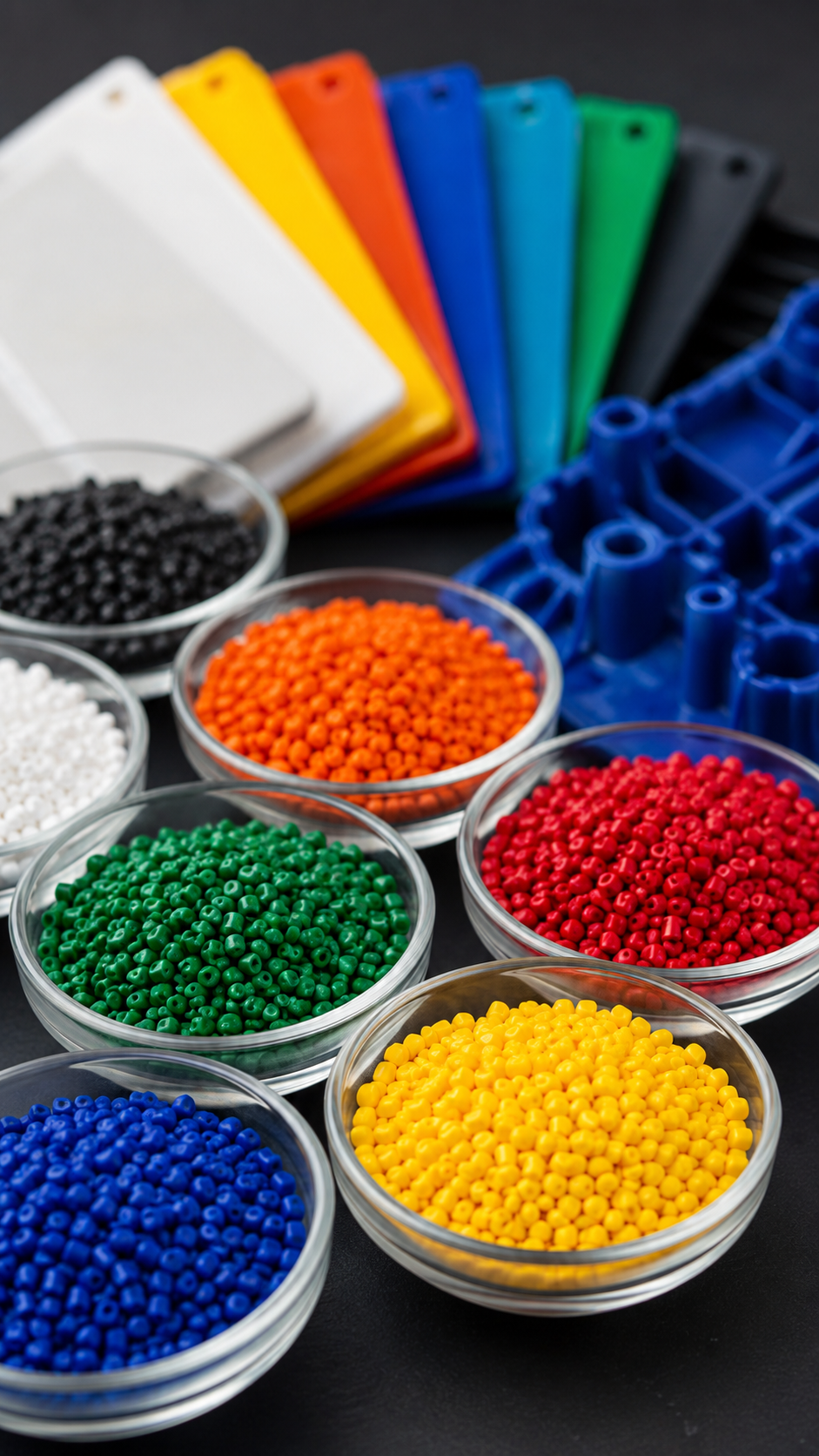
Custom colorants allow manufacturers to match corporate branding, identify product lines, distinguish assembly components, improve workplace safety, or meet customer-specific requirements. Color coding can simplify assembly processes, reduce manufacturing errors, and improve product recognition in the field.
In regulated industries, consistent color matching may also be important for maintaining brand standards across multiple production runs.
Modern color concentrates can be formulated to achieve virtually any shade while maintaining consistency from one batch to the next. In many cases, manufacturers can match specific color standards or customer requirements without compromising the material’s overall performance.
Selecting the proper colorant is important because different pigments may influence processing characteristics, heat absorption, or long-term weathering performance. Working with an experienced injection molding partner helps ensure color selection supports both the visual and functional goals of the finished product.
UV Stabilizers Protect Products Used Outdoors
Plastic components that perform exceptionally well indoors may deteriorate much more quickly when exposed to prolonged sunlight.
Ultraviolet (UV) radiation can gradually break down certain polymers, leading to:
- Fading
- Surface chalking
- Brittleness
- Cracking
- Reduced mechanical strength
- Shortened product life
For products intended for outdoor environments, UV stabilizers can dramatically improve long-term durability.
These additives help protect the polymer structure from UV degradation, allowing components to maintain their appearance and structural integrity over extended periods of exposure.
Industries that frequently benefit from UV stabilization include:
- Agriculture
- Marine equipment
- Construction
- Outdoor recreation
- Telecommunications
- Infrastructure
- Automotive exterior components
Selecting the appropriate UV protection depends on both the material being used and the environmental conditions the part will experience throughout its service life.
Glass Fillers Increase Strength and Stability
Some applications require greater rigidity than a standard resin can provide.
Glass fiber reinforcement is one of the most common ways to significantly improve the mechanical properties of engineering plastics such as nylon.
Adding glass fibers can increase:
- Tensile strength
- Stiffness
- Dimensional stability
- Heat resistance
- Load-bearing capability
Glass-filled materials are widely used for structural components that must maintain precise dimensions under mechanical stress or elevated temperatures.
These reinforced materials are commonly found in:
- Aerospace components
- Industrial machinery
- Electrical housings
- Automotive systems
- Defense applications
Although glass-filled materials provide substantial performance benefits, they also require careful tooling design and processing expertise to achieve optimal results.
Lubricating Additives Improve Wear Performance Production
Not every plastic component remains stationary.
Parts such as gears, bushings, bearings, rollers, and sliding mechanisms experience continuous movement throughout their service life.
For these applications, lubricating additives can significantly reduce friction between moving components.
Materials may incorporate additives such as PTFE or other wear-reducing modifiers that help improve:
- Wear resistance
- Surface lubricity
- Operating efficiency
- Component lifespan
- Maintenance intervals
Reducing friction can also decrease heat generation during operation, contributing to improved reliability in demanding industrial environments.
Flame Retardants for Critical Safety Applications
Many industries require plastic components that meet specific fire safety standards.
Electrical systems, industrial controls, transportation equipment, and aerospace applications often require flame-retardant materials capable of slowing combustion and reducing flame spread.
Rather than changing the base resin entirely, specially formulated flame-retardant additives can often be incorporated into the material while maintaining many of its original mechanical properties.
Selecting flame-retardant materials involves balancing multiple performance factors, including strength, temperature resistance, regulatory compliance, and long-term durability.
Understanding the end-use environment is essential when determining the most appropriate formulation.
Impact Modifiers Increase Toughness
Some products are designed to withstand repeated impacts, drops, or sudden loading.
Without modification, certain plastics may crack or fracture when subjected to these conditions.
Impact modifiers are designed to improve a material’s toughness by increasing its ability to absorb energy before failure.
These additives are commonly used in:
- Equipment housings
- Protective covers
- Consumer products
- Power tools
- Transportation components
Improved impact resistance often translates directly into longer product life and fewer warranty issues for manufacturers.
Surface Texture and Finish Play an Important Role Strategy
Customization isn’t limited to what happens inside the material.
The appearance and feel of a finished component are often just as important as its mechanical performance.
Many surface textures are created through the mold itself using specialized finishing techniques such as bead blasting, chemical etching, or EDM texturing. These processes allow manufacturers to produce everything from smooth, high-gloss finishes to matte or textured surfaces.
Depending on the application, textured finishes can offer several advantages:
- Improved grip
- Reduced glare
- Enhanced appearance
- Better scratch resistance
- Less visible fingerprints and wear
- Premium product feel
Material selection can also influence the final appearance. Certain additives can reduce gloss, create matte finishes, or improve surface consistency.
Achieving the desired finish often requires close collaboration between material selection, mold design, and processing parameters to produce consistent cosmetic results.
Specialty Additives for Unique Applications
Beyond the most common performance enhancements, many specialized additives are available to address unique application requirements.
Depending on the product, manufacturers may incorporate additives that provide:
- Antimicrobial protection
- Static dissipation
- Electrical conductivity
- Improved chemical resistance
- Enhanced weatherability
- Processing improvements
- Reduced moisture absorption
These specialty formulations allow engineers to design components that perform reliably in highly demanding operating environments while meeting industry-specific requirements.
As technology continues to evolve, material science continues to expand the range of available customization options for plastic injection molding.
Why Material Customization Matters
One of the greatest misconceptions about plastic injection molding is that manufacturers simply select a resin from a catalog and begin production.
In reality, successful product development often involves carefully balancing material properties, environmental conditions, manufacturing processes, regulatory requirements, and overall project costs.
Material customization allows engineers to optimize products without necessarily changing the entire design. Small adjustments to a material formulation can significantly improve durability, extend product life, enhance appearance, or solve performance challenges that would otherwise require more costly redesigns.
For companies developing new products or improving existing ones, these customization options can provide meaningful competitive advantages.
Partnering with an Experienced Custom Injection Molder
Material selection should never be viewed as a one-size-fits-all decision.
Every application presents its own combination of mechanical, environmental, cosmetic, and regulatory requirements. An experienced custom injection molder works alongside customers to evaluate these factors early in the design process, helping identify material solutions that support both product performance and manufacturability.
At Nylacarb, every project begins with understanding the customer’s application—not simply selecting a resin. By considering how a part will function, where it will be used, and what demands it will face throughout its lifecycle, the team can recommend material modifications that improve performance, consistency, and long-term value.
From custom color matching and UV protection to glass-filled materials and specialty performance additives, the right material formulation can make all the difference in the success of a finished product.
Whether you’re developing a prototype or preparing for high-volume production, partnering with a knowledgeable custom injection molder helps ensure your material is engineered not only for manufacturing—but for real-world performance.
Have more questions?
👉 Contact us today to discuss your next project.